- Decision
Organize design by pods.
- Why
- One designer per app made four silos and left no cover for a holiday. Pods group work by merchant problem: alerts and pre-orders, memberships and promotions, the AI assistant.
- Trade-off
- Designers trade some depth in a single app for breadth, and two PMs share one pod’s time.
- Risk watched
- Pod priorities clashing. Checked in the monthly capacity review; rebalanced twice in the year.
- Owner
- Me, with the four PMs
Building a design team for four Shopify apps
In twelve months I grew design from two of us taking tickets to a six-person team with pods, rituals, a budget and a monthly page leadership reads.
Impact
Design team
Design team: from 2 to 6
12 months, 4 hires
Median time-to-hire
Median time-to-hire: 38 days, per hire
Application to signed offer
Design budget
Design budget: within 3%, plan vs actual
Of plan, FY 2025–26
General notes6-minute sheet
The 60-second version
- The ask: one design team for four apps, with numbers leadership could read.
- I reorganized design into three pods and a research seat, hired four designers on one rubric and started crit.
- Every month I gather a HEART scorecard per app and send leadership one page.
- A year on: six people, no one has left, handoff −35%, budget within 3%.
Challenge
Existing conditions
“I file the ticket and hope design has a free afternoon,” a PM told me in my first week.
Design was one designer and me, taking tickets from four product teams, with no shared library, no crit and no numbers leadership could read. Every PM had a direct line into a designer’s calendar, and work was judged by how fast it shipped. Leadership saw design as a cost line, so every headcount ask started from zero.
Scope of work
My role
I led…
- Designed the team: pods, roles, rituals and a four-level career ladder
- Hired four designers with scorecards, a paid exercise and one written rubric
- Owned the design budget and planned capacity in designer-weeks
- Gathered the monthly HEART scorecard and wrote the leadership brief
- Kept most of my week on hands-on design and review
The team…
- Five designers owned their pod’s outcomes, from discovery to design QA
- Two senior designers took over running crit by month nine
- Product and engineering leads co-wrote the definition of ready and the quarterly plan
- 1 × Design lead (me)
- 4 × Product designers
- 1 × Research & content designer
- 4 × Product managers
- 3 × Engineering leads
Constraints
What we had to work within
- Four apps, four PMs, one design budget
- Built-for-Shopify requirements in every app
- Headcount released two roles at a time
- Hybrid team: Vancouver office plus remote
- No recruiter and no design-ops role
Principles
What we held to
P1
Pods own outcomes; crit keeps us one team.
Each pod answers for its app’s numbers. A weekly crit and one shared library stop four apps drifting into four products.
P2
Hire for judgement; train for tools.
Scorecards before job posts, one written rubric for every panel, and a paid exercise that respects a candidate’s time.
P3
Leadership gets one page, every month.
Shipped, moved, at risk, asks. If leadership has to ask what design did last month, the page has already failed.
Decision log
Decisions
- Decision
A paid three-hour exercise instead of an unpaid take-home.
- Why
- Unpaid take-homes took candidates eight to twelve hours and quietly filtered out parents and people with second jobs. A paid, timed exercise on a real problem showed judgement in three.
- Trade-off
- CA$300 per candidate and more of my calendar; fewer people reach the exercise stage.
- Risk watched
- Inconsistent scoring. Every panellist scored the same written rubric, alone, before the debrief.
- Owner
- Me, with people operations and a senior designer
- Decision
A dedicated design-ops hire.
- Why
- Someone had to own the library, tooling and rituals, but a full-time ops role in a team of six would have cost a designer seat on the product.
- Trade-off
- Ops became a rotating seat, one designer per quarter at 20% time, and the headcount went to a product designer.
- Risk watched
- Library and tooling work slipping behind delivery. Watched through office-hours attendance and the definition of ready.
- Owner
- Me
- Decision
A HEART scorecard per app, every month.
- Why
- Leadership didn’t need to know how many screens we made. They needed to know whether merchants set up, came back and succeeded.
- Trade-off
- Slower to stand up: analytics events in four apps and a standing panel of 40 merchants. The first three briefs ran without merchant-panel numbers.
- Risk watched
- Numbers nobody acts on. Any signal that changes no decision for two quarters is dropped.
- Owner
- Me, with the four PMs and our data analyst
Team design
Three pods for four apps
My first month was a listening tour: every PM, every engineering lead and twenty merchant calls. Four apps were drifting into four products, and nobody could take a holiday.
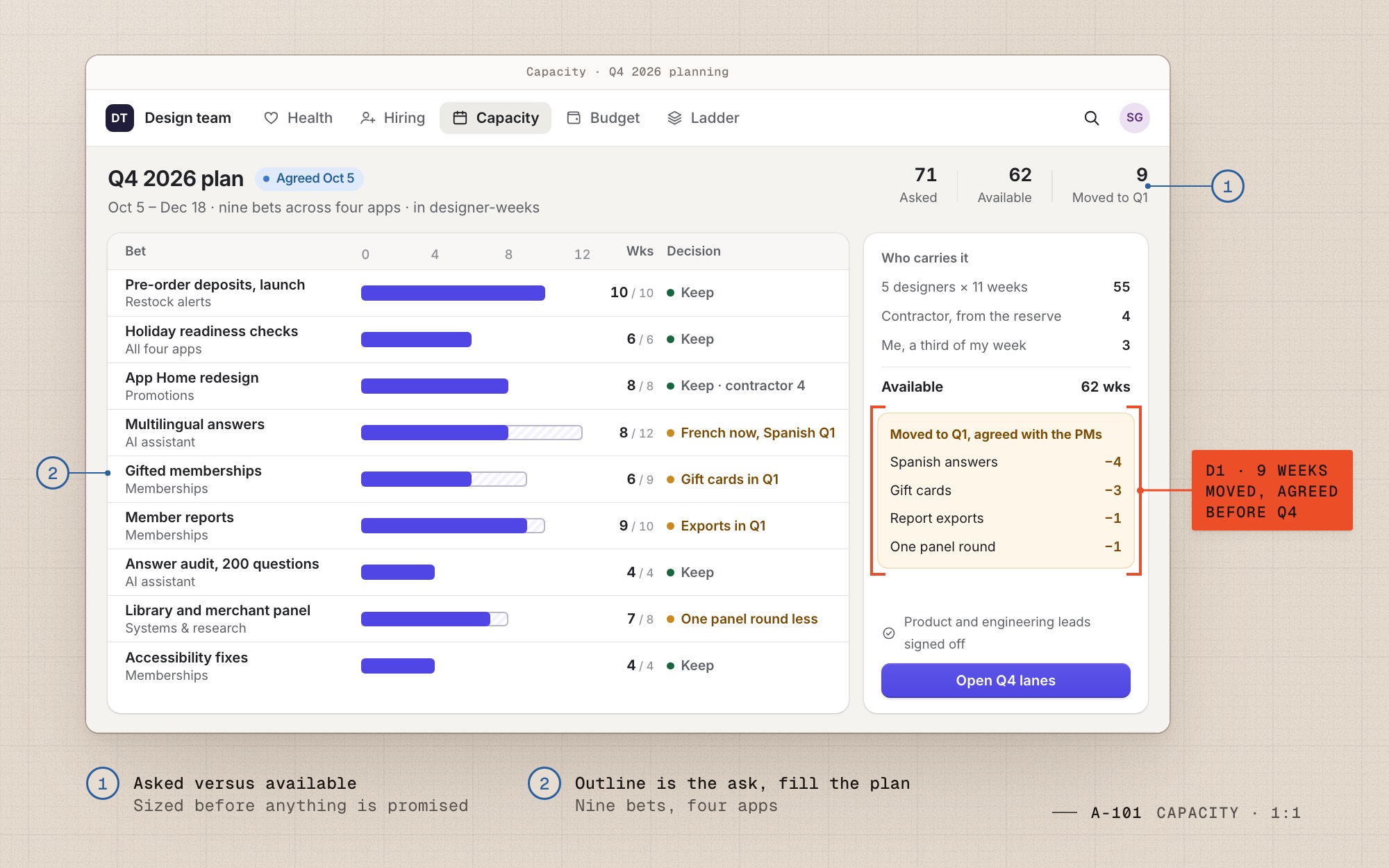
I moved design to three pods and a shared research and content seat. Capacity is planned in designer-weeks every quarter and rebalanced with product when the bets change.
Restock alerts: Setup in 4 steps (done), Pre-order deposits (active); Memberships: Member portal v2 (done), Gifted memberships (planned); Promotions: Promotion calendar (active), Polaris migration (active); AI assistant: Hand-off v2 (active), Answer audit (planned); Systems & research: Library, merchant panel (active)
Restock alerts14 wksSetup in 4 steps4 wksPre-order deposits10 wks
Memberships16 wksMember portal v210 wksGifted memberships6 wks
Promotions10 wksPromotion calendar6 wksPolaris migration4 wks
AI assistant18 wksHand-off v212 wksAnswer audit6 wks
Systems & research6 wksLibrary, merchant panel6 wks
64 designer-weeks
View as table
| Lane | Item | When | Status |
|---|---|---|---|
| Restock alerts | Setup in 4 steps | Jul | Done |
| Restock alerts | Pre-order deposits | Aug → Sep | Active |
| Memberships | Member portal v2 | Jul → Aug | Done |
| Memberships | Gifted memberships | Sep | Planned |
| Promotions | Promotion calendar | Jul → Sep | Active |
| Promotions | Polaris migration | Aug → Sep | Active |
| AI assistant | Hand-off v2 | Jul → Sep | Active |
| AI assistant | Answer audit | Sep | Planned |
| Systems & research | Library, merchant panel | Jul → Sep | Active |
64 designer-weeks, planned with product before anything was promised and rebalanced every quarter.
Fig. 01 D1Q3 capacity by app: three pods across four apps, plus the research and content seat.
Hiring
One rubric, four hires, 38 days
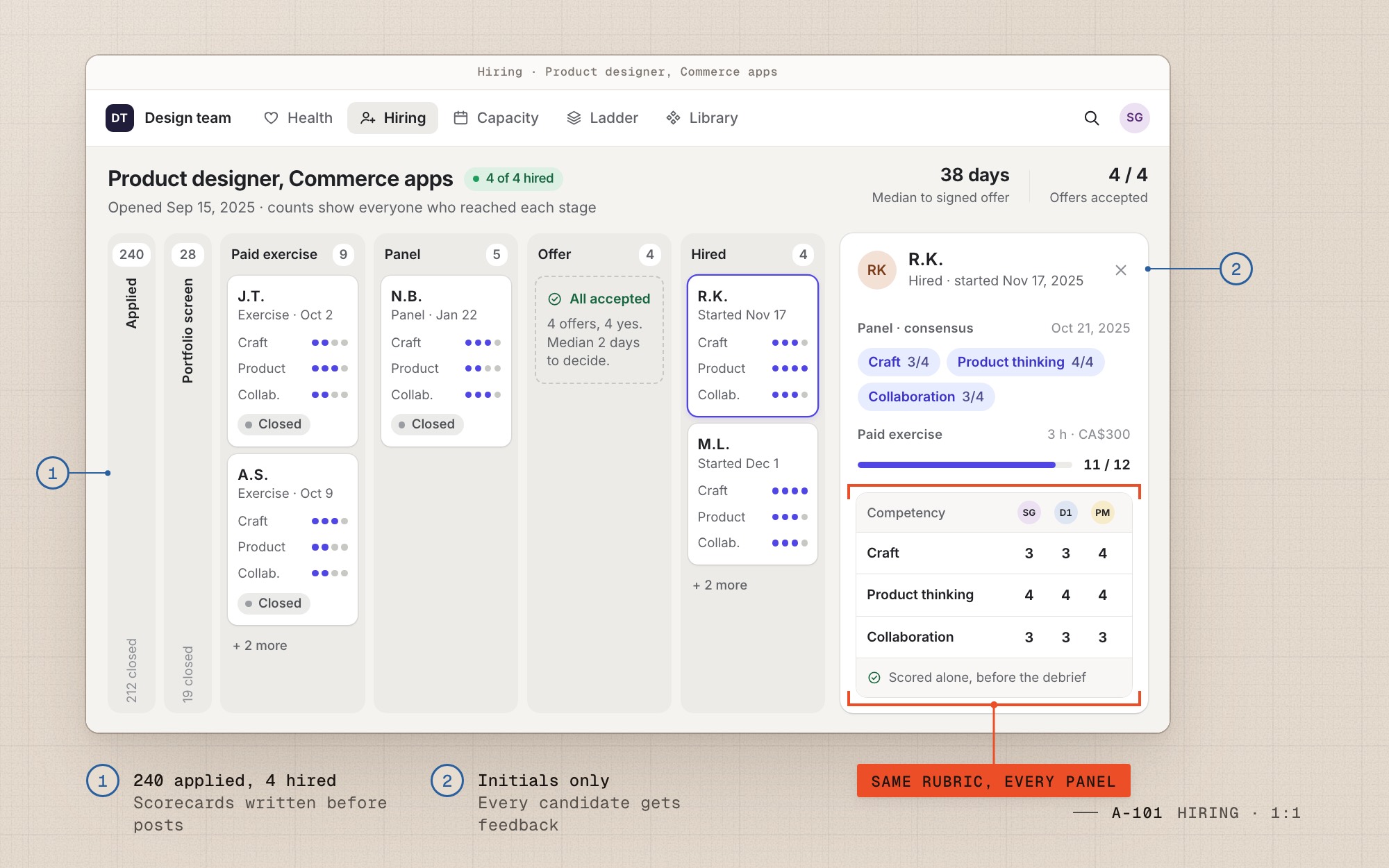
I wrote the role scorecards before the job posts, then ran every candidate through the same steps: a portfolio screen, a paid three-hour exercise and a panel scored on one written rubric.
240 people applied. Four offers went out and all four were accepted, a median of 38 days from application to signed offer.
Budget
Designer-weeks first, dollars second
I own the design budget: CA$180,000 a year outside salaries, for contractors, tools and licences, research incentives and learning. I plan capacity first, then dollars, and hold 8% in reserve for the quarter that goes sideways.
The hire I didn’t make was design ops. A rotating ops seat gave that headcount to a product designer.
| Category | Plan | Actual | Variance | Why it moved |
|---|---|---|---|---|
| Contractors | CA$68,400 | CA$69,500 | +1.6% | Two prototyping sprints for the AI assistant |
| Tools & licences | CA$43,200 | CA$45,600 | +5.6% | Seats for four hires, a quarter earlier than planned |
| Research incentives | CA$32,400 | CA$34,800 | +7.4% | Merchant panel grew from 30 to 40 stores |
| Learning | CA$21,600 | CA$20,100 | −6.9% | One conference moved to next year |
| Reserve (8%) | CA$14,400 | CA$14,300 | −0.7% | Six-week design contractor for Promotions (D3) |
| Total | CA$180,000 | CA$184,300 | +2.4% | Within 3% of plan |
Spend outside salaries, October 2025 to September 2026. The year landed 2.4% over plan, inside the 3% band I committed to.
Fig. 03 D3No ops hire: a rotating ops seat, and an 8% reserve that covered a contractor when Promotions slipped.
Gathering the numbers
Numbers someone will act on
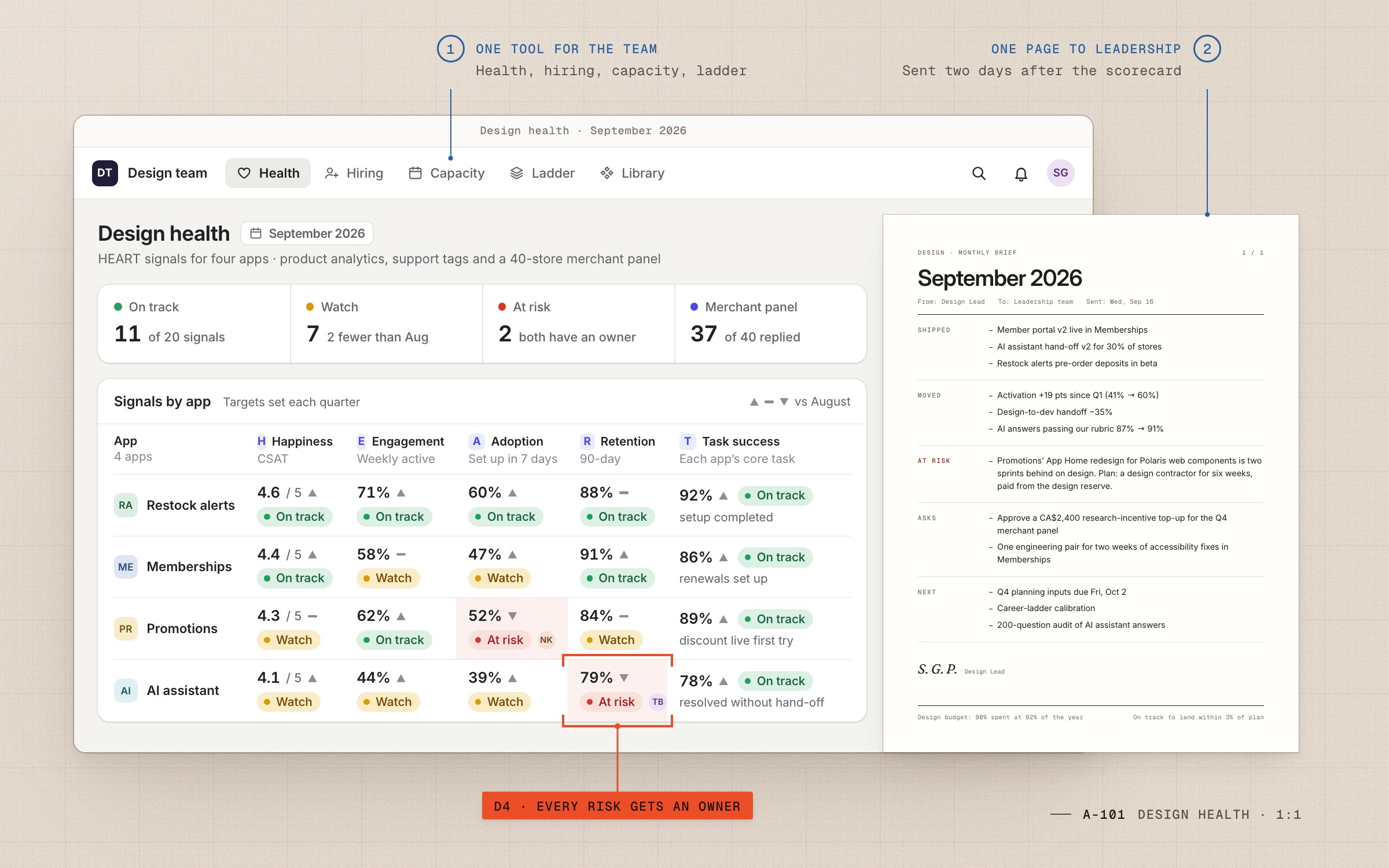
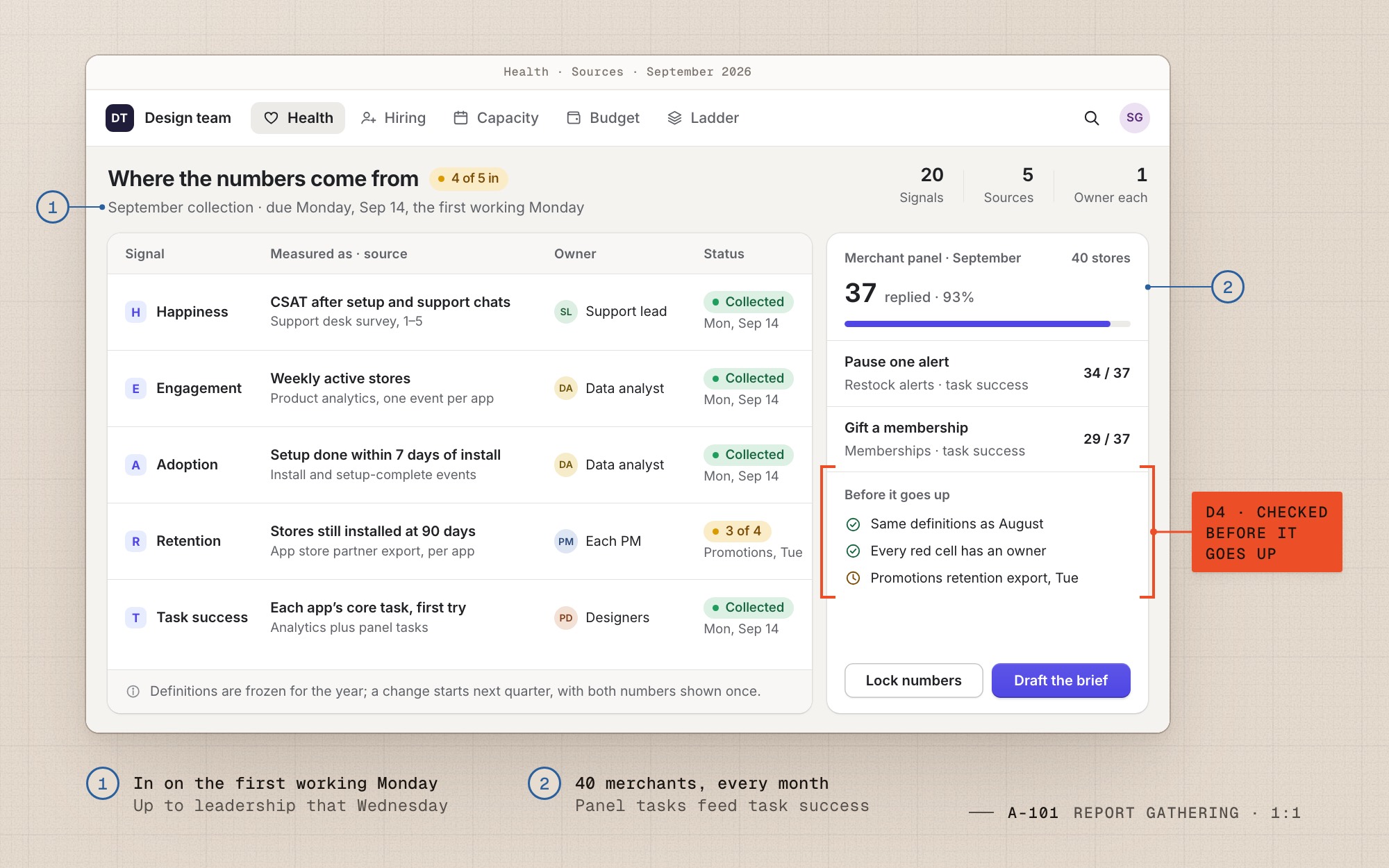
On the first working Monday of every month I gather a HEART scorecard for each app from product analytics, support tags and a standing panel of 40 merchants.
The team sees exactly what leadership sees. Every status is a word, so a red cell never needs a meeting to explain it.
Restock alerts Happiness: 4.6 / 5, trend up, On track; Restock alerts Engagement: 71%, trend up, On track; Restock alerts Adoption: 60%, trend up, On track; Restock alerts Retention: 88%, trend flat, On track; Restock alerts Task success: 92% setup completed, trend up, On track; Memberships Happiness: 4.4 / 5, trend up, On track; Memberships Engagement: 58%, trend flat, Watch; Memberships Adoption: 47%, trend up, Watch; Memberships Retention: 91%, trend up, On track; Memberships Task success: 86% renewals set up, trend up, On track; Promotions Happiness: 4.3 / 5, trend flat, Watch; Promotions Engagement: 62%, trend up, On track; Promotions Adoption: 52%, trend down, At risk; Promotions Retention: 84%, trend flat, Watch; Promotions Task success: 89% discount live first try, trend up, On track; AI assistant Happiness: 4.1 / 5, trend up, Watch; AI assistant Engagement: 44%, trend up, Watch; AI assistant Adoption: 39%, trend up, Watch; AI assistant Retention: 79%, trend down, At risk; AI assistant Task success: 78% resolved without hand-off, trend up, On track
Restock alerts4.6/ 5▲On track71%▲On track60%▲On track88%▬On track92%setup completed▲On track
Memberships4.4/ 5▲On track58%▬Watch47%▲Watch91%▲On track86%renewals set up▲On track
Promotions4.3/ 5▬Watch62%▲On track52%▼At risk84%▬Watch89%discount live first try▲On track
AI assistant4.1/ 5▲Watch44%▲Watch39%▲Watch79%▼At risk78%resolved without hand-off▲On track
View as table
| App | Happiness (CSAT) | Engagement (weekly active stores) | Adoption (set up in 7 days) | Retention (90-day) | Task success |
|---|---|---|---|---|---|
| Restock alerts | 4.6 / 5 ▲ On track | 71% ▲ On track | 60% ▲ On track | 88% ▬ On track | 92% setup completed ▲ On track |
| Memberships | 4.4 / 5 ▲ On track | 58% ▬ Watch | 47% ▲ Watch | 91% ▲ On track | 86% renewals set up ▲ On track |
| Promotions | 4.3 / 5 ▬ Watch | 62% ▲ On track | 52% ▼ At risk | 84% ▬ Watch | 89% discount live first try ▲ On track |
| AI assistant | 4.1 / 5 ▲ Watch | 44% ▲ Watch | 39% ▲ Watch | 79% ▼ At risk | 78% resolved without hand-off ▲ On track |
One row per app, every month, from product analytics, support tags and a standing panel of 40 merchants. Status is always a word.
Fig. 04 D4September 2026: twenty signals, two at risk, each with a named owner.
Reporting up
One page, every month
Leadership gets one page from me every month, two days after the scorecard: what shipped, what moved, what’s at risk and what I need. Twelve briefs in twelve months; the first three carried support and analytics numbers only, because the merchant panel took a quarter to stand up.
The asks on that page are how the design budget gets decided. When Promotions slipped, the risk, the fix and its cost were in the brief before anyone asked.
One page every month, two days after the scorecard. Twelve of twelve sent on time.
Fig. 05 The September 2026 brief as it went to the leadership team.
Rituals & growth
Rituals light enough to keep
A weekly crit, two design reviews with engineering, one shared library and a written definition of ready cut the time from design done to in development by 35%.
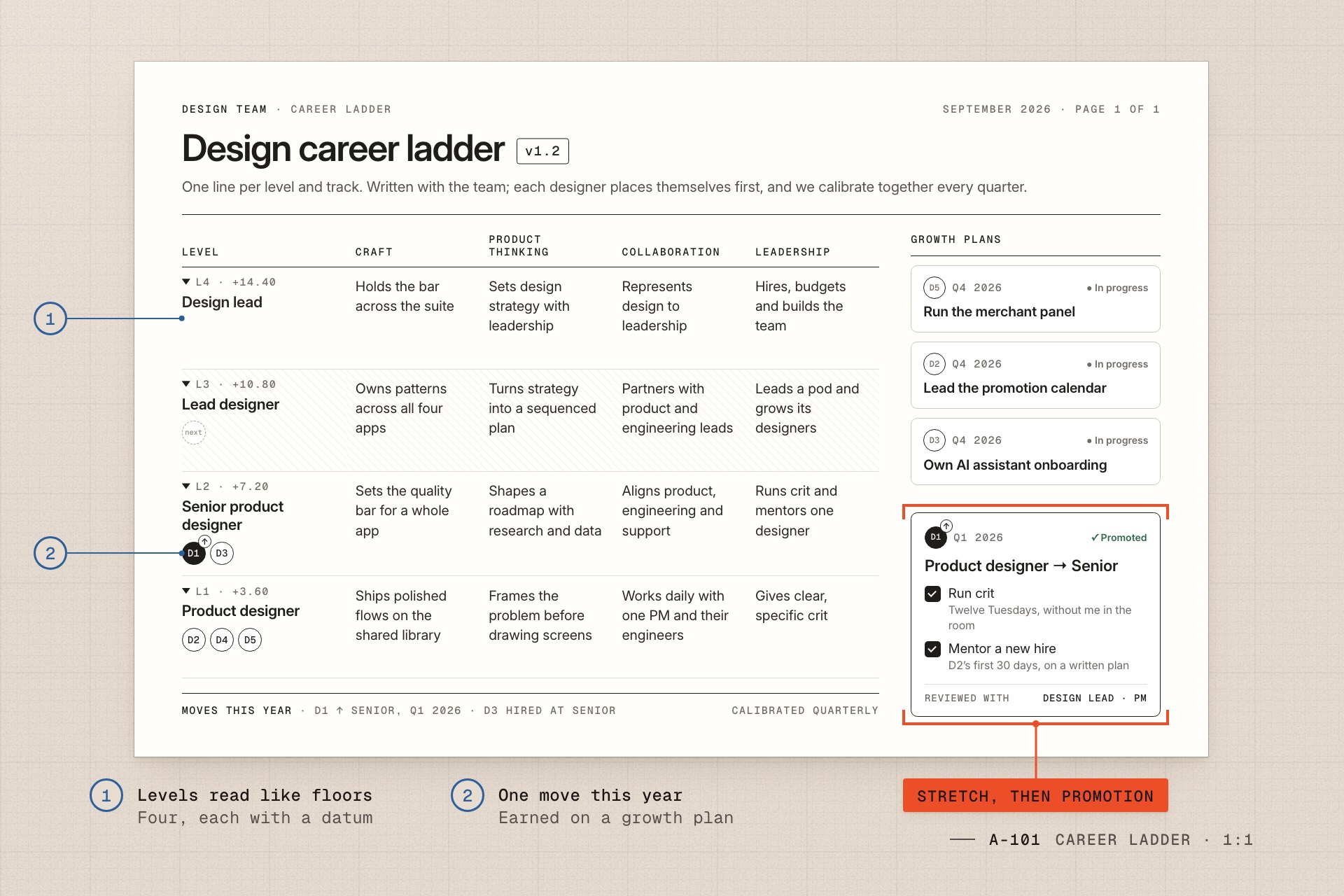
Every designer has a 1:1 every two weeks and a growth plan on a four-level ladder we wrote together. Two designers now run crit without me.
Before / after
Organize design by pods.


Key screens
Key screens
01 / 04
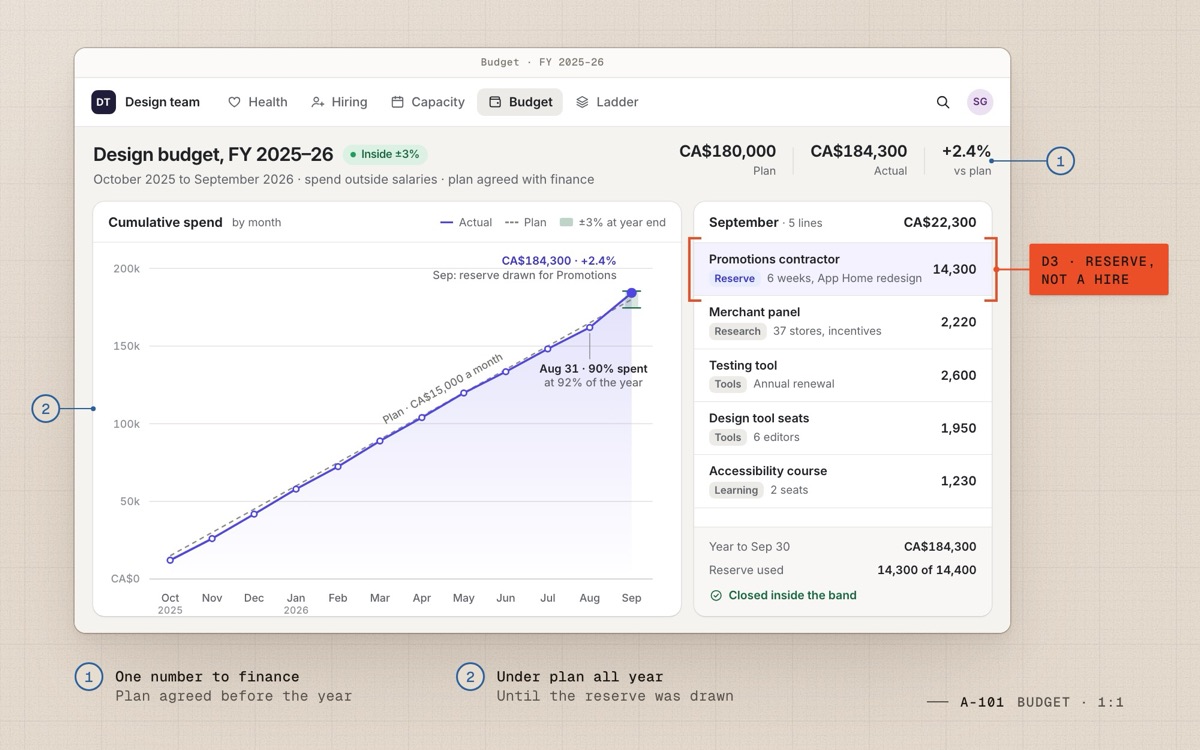
Fig. 08 D3The design budget month by month: under plan until the reserve paid for the Promotions contractor. Landed +2.4%. 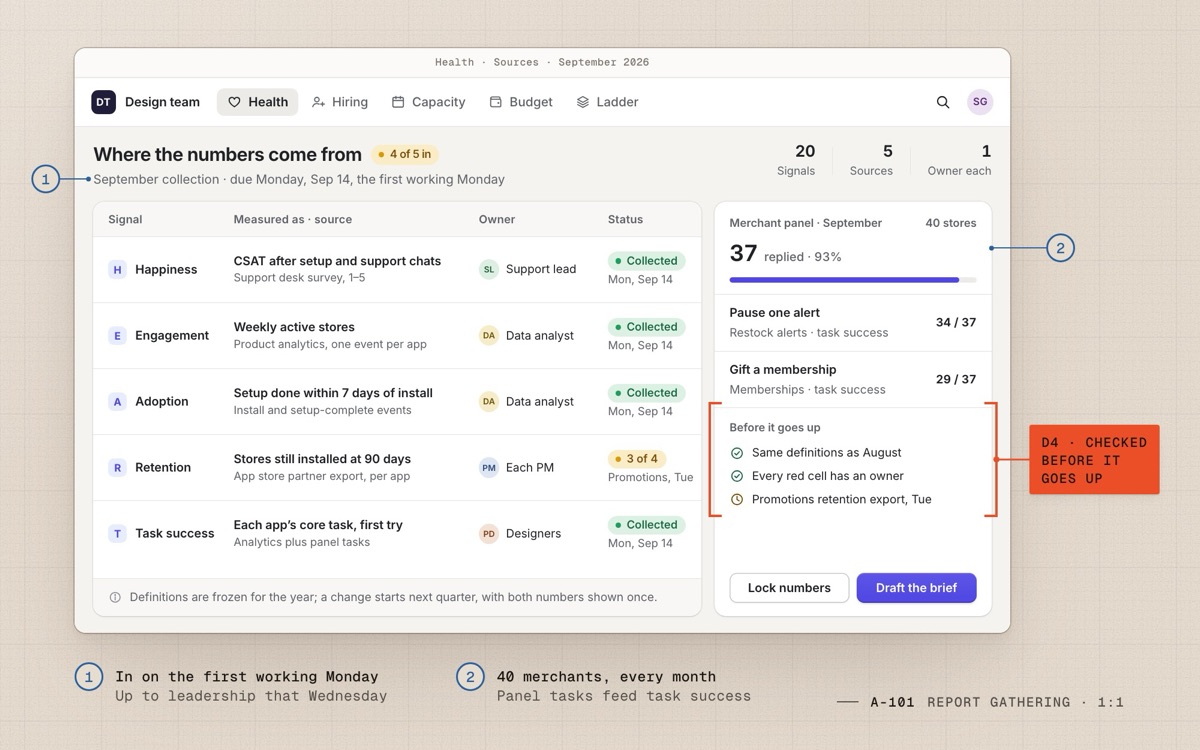
Fig. 09 D4Report gathering: every HEART signal has one source and one owner, checked before the brief goes up. 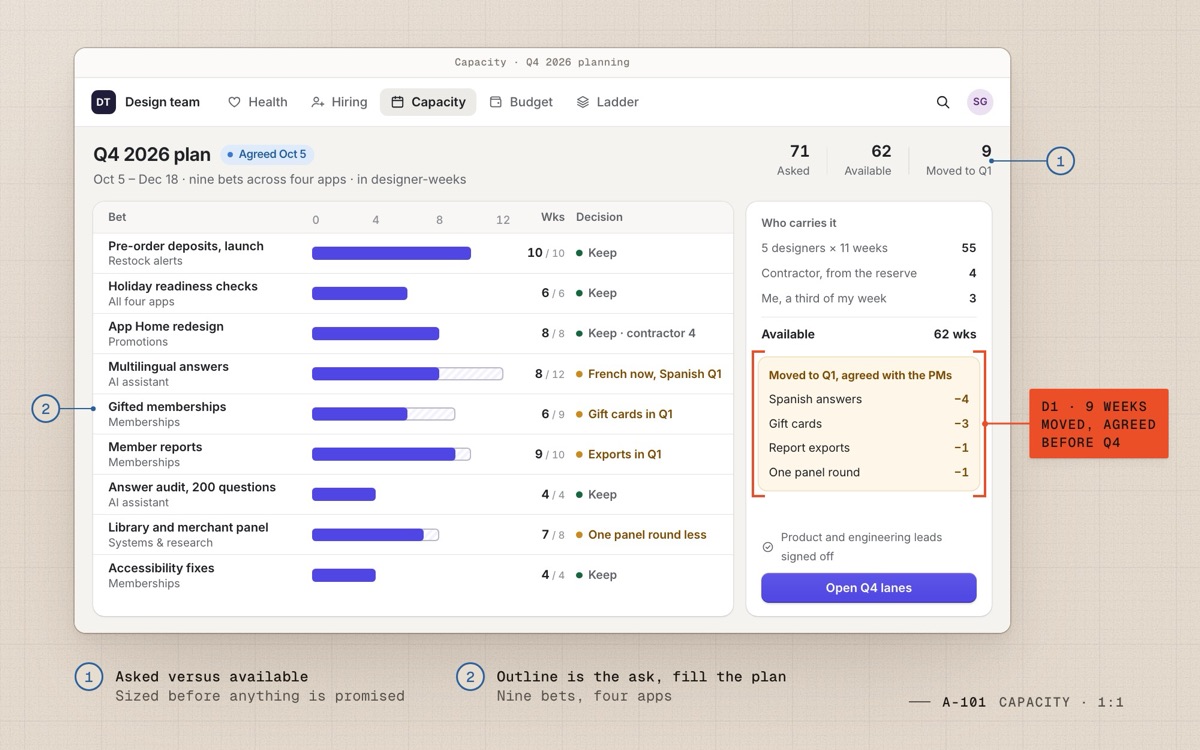
Fig. 10 D1Q4 planning in designer-weeks: 71 asked, 62 available, and the 9 that moved to Q1 agreed with the PMs. 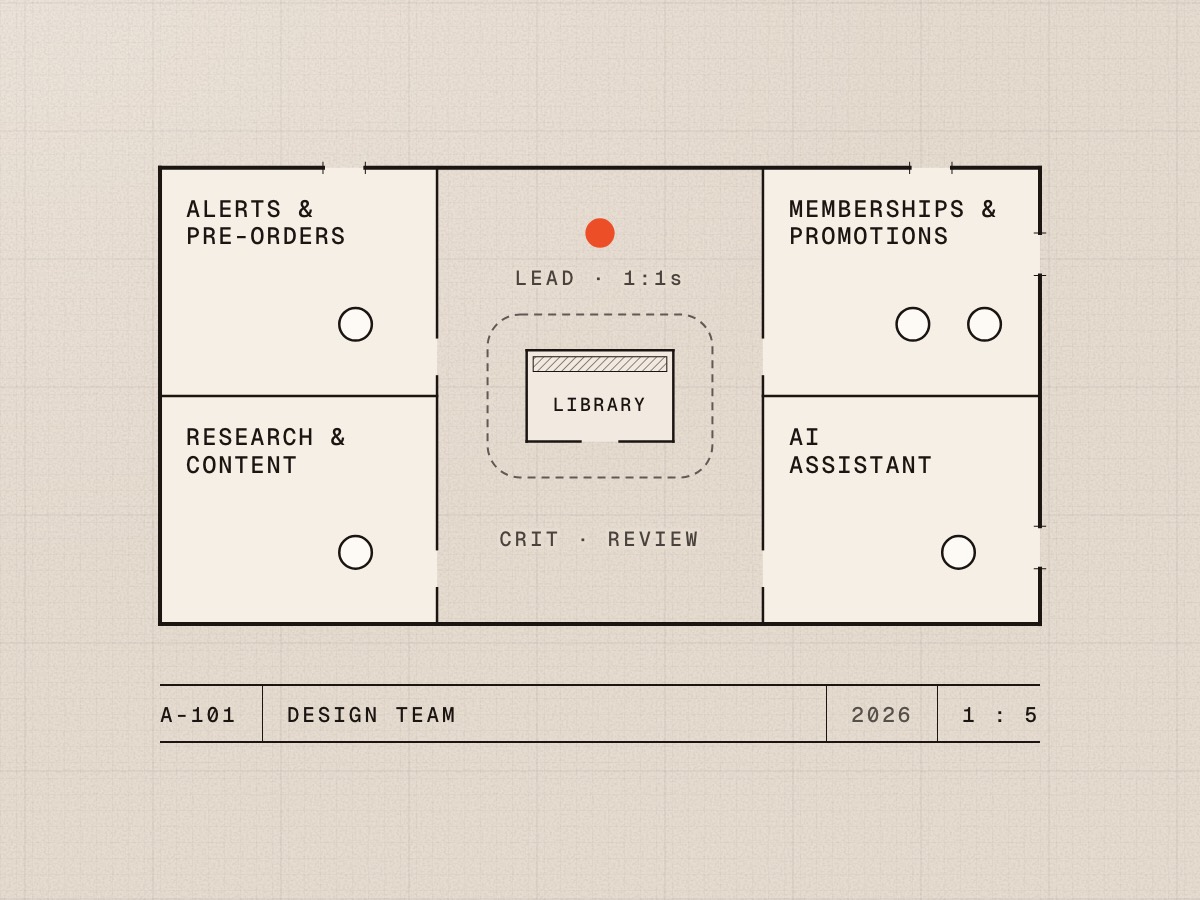
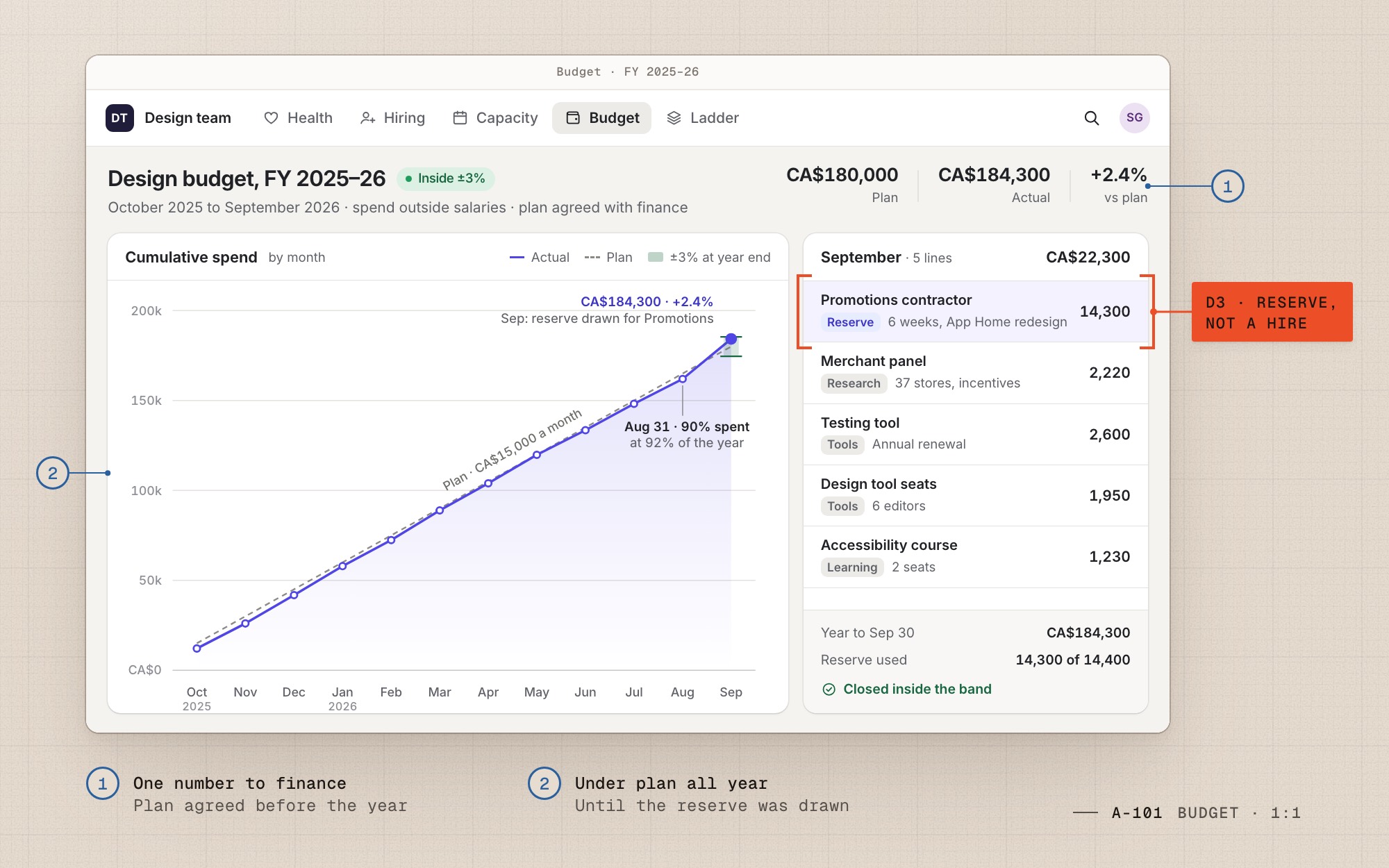
Fig. 11 D1The team as a plan: three pods, a research seat and a library, joined by crit, review and 1:1 corridors.
Outcomes
After launch
- Launch
2026
- +3 months
Team 2 → 4
First two hires in; crit every Tuesday
- +6 months
Handoff −35%
Shared library and a written definition of ready
- +12 months
Within 3% of plan
Team of six, no one has left, budget landed
Learnings
Revisions
Paths not taken
- One designer per app. Simple to explain, but it made four silos and left no one to cover a holiday.
- A design-team dashboard of screens shipped and tickets closed. It measured our activity, not the merchant’s outcome.
- A full-time design-ops hire in a team of six. A rotating seat did the job and kept a designer on the product.
Two reflections
- I hired for judgement and it paid off, but I under-invested in onboarding. The first two hires took eight weeks to ship on their own; a written 30-day plan got the next two there in four.
- Reporting up felt like overhead until the month it wasn’t. When Promotions slipped, the brief had already named the risk and the fix, and the budget conversation took ten minutes.
Go deeper
Details
Detail 1The hiring rubric
Each role had a one-page scorecard written before the post: three outcomes for the first year and the three competencies we would test — craft, product thinking and collaboration.
Panellists scored each competency from 1 to 4, alone and in writing, before the debrief. We hired at 3 or above on all three and 4 on at least one.
Detail 2What goes in the monthly brief
Five headings on one page: Shipped, Moved, At risk, Asks, Next. Moved lists only numbers from the HEART scorecard. At risk always names a plan and an owner. Asks always carry a price or a person.
It goes out on the Wednesday after the scorecard lands, so the team and leadership argue from the same numbers.
Detail 3How the ladder was written
Four levels by four tracks, one line each. I drafted it and the team rewrote it in two workshops; every designer placed themselves first, and we calibrate together each quarter.
Growth plans name one stretch responsibility per quarter, such as running crit or owning a pod’s onboarding.
NoteCandidates and team members appear by initials only.
Continue the set

